Thursday, December 26, 2013

Wednesday, December 25

I abstained from posting on Christmas Day – far too momentous a day for us. Not only was it Christmas, but we completed the final and most dramatic leg of our trip to California.

We left Reno at sunrise, around 7:15 AM, and headed toward the Sierras. We were slowly climbing, even though at times we dropped a thousand feet or so, only to climb higher again. The slopes became steeper and more densely covered with pines and the presence of water was more apparent: creeks raced down and rapids flourished. There was ample evidence of early dams and sluices built to channel water and harness the water’s power for electricity. We reached the California border amidst intermittent freezing fog and then for the most part, the rest of the upward climb to Donner Pass was in dazzling morning sunshine.

Heading west from Reno
In California the Sierra Nevadas are magnificent. Even though there’s been a dearth of precipitation compared with most years, the mountains look fresh and vigorous. It may have been simply that after days of treeless mountains it was a relief to see the heady flourish of evergreen. A few miles after the Donner Pass we stopped again to walk the dogs at a “vista point” (the highway department’s term) where wagon trains halted and individual wagons were lowered several hundred feet to where the trail continued: the slope was too steep for the horses and wagons. I wonder if, as they gazed at the mountains around them, some settlers wondered why they couldn’t just stop here and carve out a new life. But we were tourists; those pioneers had another agenda. Come to think of it, so did we, and we too headed on.

Our first expansive view of California
In the course of nearly forty miles we descended nearly 7000 feet and were soon on the outskirts of Sacramento. We continued on, through California’s version of suburban sprawl, interspersed with clearly vibrant and extensive farming – the great Central Valley. We passed the University of California’s Davis campus, with its agricultural school and – most important to us – it’s enormous veterinary school. It’s canine ophthalmology department, the world’s largest, is where Lucca will continue his post-operative monthly exams after cataract surgery.

Another hour or less and we were over the last mountain pass just outside San Rafael. We cut across a corner of Berkeley and onto the ramp leading to the San Francisco Bay Bridge. The first segment was the newly opened section of bridge, pristine and white, that led to Yerba Buena and Treasure Island. We passed through a tunnel on the island and emerged for the final triple-suspension segments of the bridge. We were immediately struck by how close downtown San Francisco and it’s financial district loomed. We were also confronted by the steepness of its hills. Even from the distance of the bridge the vertical climb of Nob and Telegraph Hills was impressive. And daunting.

All that's left...
Once off the bridge we took the first exit and in a few blocks we were pulling into our building and into our parking space. We picked up our keys from the building’s concierge and within minutes had taken the elevator up, walked the short distance of hallway and unlocked our front door. We stepped in and there it was: San Francisco. It was our Christmas present, and we were delighted!

And grateful the trip was safely over. We were famished.

After a brief unpacking (not much fits in a small car when you're traveling with demanding dachshunds whose idea of travel is not unlike the Royal Progress) Ken and I set out to find a restaurant open on Christmas Day. We walked east on King Street, past the new baseball stadium and onto the Embarcadero.

Where wagons were lowered by rope
We realized we were not going to find anything, and rather than replicate the Donner party we turned back, got the car and headed for Chinatown. Once there we found every restaurant open, and while evidence of patronage by Chinese is traditionally a sign of a first rate Chinese restaurant, we were suddenly not in the mood for an authentic cultural experience. And so it was that we happened upon Mangia Tutti, an Italian restaurant near the base of the TransAmerica tower. The proprietor greeted us warmly and said we were wise to come early (it was about 4:30 PM - we had not eaten since breakfast in Reno) because he had 150 reservations due to descend at 6:30. We were charmed by the staff and the food - perhaps the closest experience to the restaurants that delighted us in Italy - and felt afterward that we'd not only had a proper Christmas dinner celebration but also found our first "favorite" Italian restaurant in San Francisco. Who knows what Michelin thinks? Michelin and its stars did not welcome us like family on our first day and first Christmas in San Francisco.

We'll wait until friends come to visit and only then set forth to determine which of the zillions is the best Chinese restaurant in the city. But we're already thinking we need to begin research in earnest to find the best Mexican place in town. And seafood. And French. And, and, and...

More soon. Merry Christmas to you, dear friends.

There's an Italian restaurant somewhere in there...

Tuesday, December 24, 2013

Tuesday, December 24

Our final full day of travel. Sagebrush is now as common and unremarkable to us as maple trees and hay fields.

Sage brush in Nevada
It seems to be getting better and better. We left Salt Lake City as the sun rose and drove west, skirting the south shore of the Great Salt Lake and heading toward the Bonneville Salt Flats. While much of the high plain or valley in which Salt Lake City lies is absolutely flat (the ancient bed of an inland lake, once larger than the state itself) the horizontal line is punctuated dramatically and often by mountain ranges. And the drive is arrow straight and more than slightly hypnotic.

Straight west from Salt Lake City
When we reach the Nevada border the signs for installing tire chains became regular. Northern Nevada, the Great Basin, is a high still plateau regular punctuated with majestic mountain ranges (covered in snow). The pace of the drive across the state seemed to be: climb through pass through snow-capped mountains, descend into valley and stare in awe at latest range of mountains across the valley, cross the valley (looks close, takes forever) and ascend the next pass. Repeat until Reno is reached.

The sage continued to be the predominant plant material, with mountain cedar running a close second on the lower slopes of the mountains. But as we got further west and further south on Interstate 80 the sage and the cedar grow less dense and the vast valley floors and broad gentle slopes for miles up to the mountains became more and more desert like. As we grew used to the stretches of open Nevada we began to appreciate the subtle colors, the soft greens, the gentle russets, the myriad golds and the rich grays and browns. And the ever present deep blue sky.

Just before the Bonneville Salt Flats
Strewn across the northern tier of Nevada, and sparsely strewn at best, are various towns affiliated if not conceived by oil, energy and mineral companies. Ranching seemed rare at best and any other agricultural endeavor non-existent. We see one lone, but clearly well-fed, coyote along the highway. When one does stop for coffee or for gas, the cafe or the station is sure to have slot machines. Most of the billboards advertise the coveted trinity: "Slots | Cold Beer | Clean Restrooms". We certainly saw an inordinate number of slot machines at every stop, and the beer seemed to be the beverage of choice. The restrooms seemed clean enough for someone who would not see another restroom for 100 miles. I was fascinated by a side road, a two-lane highway heading off into the desert toward Las Vegas, with the sign "Next Gas 134 Miles". We tried to keep the tank at least half-full the entire drive from Salt Lake City.

Toward the East Humboldt Range in Nevada
We're now in Reno, spending the night before we enter the Promised Land. As if in preparation for finally entering California I took the car to a car wash for a much needed cleansing. Think Los Angeles classic car wash with a swarm of immigrants descending on the washed car to wipe it thoroughly dry. Across the major thoroughfare was a massive Costco and across the side street was the entrance to both a Jack-in-the-Box and an In-n-Out Burger. Decidedly one aspect of California culture. Ditto the clean car fetish. The link, for food fanatics of a lesser order: http://www.in-n-out.com

We're tired of driving, the dogs are surely tired of riding, and the hotel routine is getting stale, too. Tomorrow we descend from the Sierra Nevadas, cross the Central Valley, cross San Francisco Bay from Berkeley, and arrive at our destination and our new home.

Approaching Reno, things dry out - hillsides like elephant hide
Later that night: Indeed we are in Reno and it's Christmas Eve. We were hungry, it was the dinner hour in at least one of the time zones we've been through. We ventured forth. To a casino (at our sister-in-law's suggestion -"Go to a casino buffet!"). We pulled into the Atlantis Casino and Hotel. The parking lots were jammed but somehow our parking place goddess intervened and we found ourselves squeezing into a narrow spot near the hotel's main entrance. We entered and were hit, assaulted, bombarded by slot machines and various electronic versions of card games and surely every other game of chance devised in the course of history. We found a hotel/casino map and found that restaurants and buffets were strewn about the hotel on nearly every level of the twenty-floor structure. We had read that Toucan Charlie's was voted "best buffet" in Reno every year since the beginning of time. We found the place. A mob scene, with a line not unlike that of a Walmart just before opening on Black Friday. We opted, on another floor, for a regular restaurant. The prices were not unlike Manhattan's. In fact the place, Bistro Napa, could have been in New York save for the fact that we were seated without a reservation (at 5:30 PST who needs a reservation?) and the obvious difference: Californians (and that's who comes to gamble in Nevada on Christmas Eve) don't rise to any occasion in terms of dress, the men especially. But the food: Ken had French onion soup served in - an onion. I had scallop and shrimp ceviche with mango and nasturtiums. Both were all right but it was clear that presentation was intended to trump everything else, including taste. The "Wow" factor seems to be the goal here. Ken had a portobello mushroom vegetarian affair that looked quite good (it was) and I had côte de veau forestiere. We shared a crème brûlée and the check was presented with a salver of shockingly good vanilla cotton candy. The cotton candy was shaped like a matronly beehive and was, perhaps, an homage to some California grandmother with a hair-sprayed pink coiffure. Odd, but tasty and it ushered us back to the parking lot in a very festive mood. Bonus: we found our way back to the hotel without getting lost. And the dogs were sleeping when we walked in, surely while visions of sugar plums danced in their heads. Change that to bones and we have a Christmas Eve. Unorthodox but still filled with the spirit of the season. Merry Christmas!

And imagine coming down the stairs on Christmas morning to this:

Imagine this ten thousand fold

Monday, December 23, 2013

Monday, December 23

We've arrived in Salt Lake City. Despite less than ideal weather the day's leg of our journey was the most spectacular so far. Leaving Cheyenne we crawled along - hoping that the highway would not be closed - through blowing snow and very ugh winds. Every vehicle had its emergency blinking light on which helped greatly since the snow was blinding at times. We finally made it to Laramie and things improved a good deal.

Still windy, but the snow has subsided
There continued to be snow and steering wheel gripping gusts of wind but the drive through the Continental Divide Basin was fascinating. In dividing into two segments in southern Wyoming, the Continental Divide created a broad high plain whose waters drained neither east or west. Not exactly a problem: the area, which is the Red Desert, gets less than 8 inches of rain annually. Most of the ground water is snow melt and mud flats in season are as good as it gets. The area is rich in natural gas, minerals and shale oil/gas. The desert landscape is peppered with energy-related facilities and wind turbines. Given the scale of the landscape this manmade intrusions are not entirely overwhelming, but after a wind turbine-free Nebraska it came as a shock to see legions of tall turbine masts marching across the broad plains. As we drove west toward Rock Springs the landscape began to resemble the American Southwest: mesas, buttes, arroyos and mountains. And finally plant life emerged again, mainly creosote, sage brush and mountain cedar.

Suddenly it was clear, but not for long
Things to a dramatic change for the, well for the dramatic once we entered Utah: we descended from about 7200 feet in a seemingly endless canyon of deep red rock, with vertical cliffs topped by cedars clinging perilously. Our descent seemed endless and then suddenly we were in Provo and confronted the steep mountain walls of seemingly endless ski areas. Interestingly the condos - a sea of real estate development - blends remarkably well into the mountain sides and is almost a form of architectural camouflage. Apparently our descent had barely begun and as we left Provo for the final drop into Salt Lake City (and the endless descent really was like that encountered on an airline flight) we entered some of the most dramatic valleys of the Wasatch Range. There were all sorts of warning about checking one;s brakes and then we silly drove down and down and down through gorgeous snow covered mountains until the narrow valley suddenly opened to reveal the broad mountain-ringed plain and the Great Salt Lake that is Salt Lake City.

The Bedrock Hilton?
We definitely feel like we're in the west. Tomorrow's 500 mile segment will bring us to Reno, Nevada and immediately after that we'll lose that western sensibility for California's. I don't think of California as western but instead as West Coast. California has as much past as anywhere else, but I sense that we'll also be confronting the future in ways we'll both appreciate and abhor. Of course, that's what the eight month sojourn will allow us to determine. But we're only in Salt Lake City - we have plenty of time to meet a realtor, look at house and become Mormons. A Latter Day Saints aside: at dinner tonight we perused the beer and wine menu (locally brewed beers and a wealth of California wines). One beer in particular stood out - a porter named Nitro-Polygamy Porter. If we don't make it to San Francisco, we could live here...

Instead we'll just hope for a rejuvenating night's sleep and a safe and pleasant Christmas Eve day drive across Utah and Nevada.

Salt Lake City in the distance


Sunday, December 22, 2013

Sunday, December 22

Mountain Standard Time. It's cold. Very cold. But the sky is blue and we can see for miles.

Anyone who knows Ken and me knows that, wherever we are, we envision ourselves living there. This afternoon and evening in Cheyenne, Wyoming we drove around the neighborhood north of the state capitol and thought, "Wow! Nice houses: we could live here!" Not yet. But the city has a glorious Romanesque Revival train station and blocks of fantastic late 19th century commercial buildings. Will people come and visit us if we live in Cheyenne or Laramie?

We're tired. We'll sleep on it, and we won't contact a real estate agent. After all we're still on the road.

Mid-Nebraska wheat and corn fields
Earlier today, leaving Lincoln, Nebraska we saw the cornfields and farms dwindling and the ranches and open ranges expanding. What had been a palette of straw yellows, browns and grays (it is winter after all) became at first more brown and gray, but then we realized that every other color was represented as well, albeit subdued by winter. The area around North Platte was gorgeous - Interstate 80 follows the Platte River in western Nebraska. After North Platte there began to be glimpses of the ancient rivers that carved bluffs and small mesas out of the soft rock. By the time we were nearing the Wyoming border the entire landscape looked like a location shot for a western movie. And at a late lunch after arriving in Cheyenne we realized that we were finally in the West: we were beyond the gravitational force field of the East Coast (even west of Chicago you still fell as if you're in familiar territory). Tonight I think we're driving with the only Connecticut license plate in the state.

Western Nebraska ranch land
It's snowing now, a light, soft, dry snowfall - Ken just returned with the dogs: they did not appreciate the light, the soft or the "dry". It was snow, killer of all walks.

The open sky and the enormous horizon are beautiful. Driving across the country has changed in the last 150 years. It's been 50 years since I drove several time across the country with my parents and today the concerns and arrangements one made before departure no longer are there. But even though the drive is an extended commute in a sense, it does unroll slowly enough to notice how the landscape evolves and changes. We're now at 6000 feet and when we look across the fields we can see for miles. We can see the Rockies we'll begin climbing tomorrow. Since the road follows the old trails and railway lines we inevitably see monuments and museums dedicated to those pioneer treks: the point where the rail lines from Omaha and Salt Lake City finally met, the stations where the Pony Express riders changed mounts, and the many trails whose ruts still show the weight of so many wagons. It is beautiful, beautiful country. we look forward to seeing it again when we drive back next year in another season.

Nearing the Wyoming border

Saturday, December 21, 2013

Saturday, December 21 - Part 2

I wanted to post an image of the Nebraska state capitol here in Lincoln. The building which houses the nation's only unicameral legislature was designed by architect Bertram Grosvenor Goodhue and was originally intended to be an extension of the state library (hence the 17-foot ceiling heights on each floor, planned to house library stacks). Goodhue also designed the Rockefeller Chapel at the University of Chicago, and St. Bartholomew's on Park Avenue in Manhattan. Much of his mid-career work was in the Spanish Colonial Revival style, although his Los Angeles Public Library building is decidedly Modernist in style. Like most architects, Goodhue was born on April 28th (in his case, the year was 1869).


Saturday, December 21

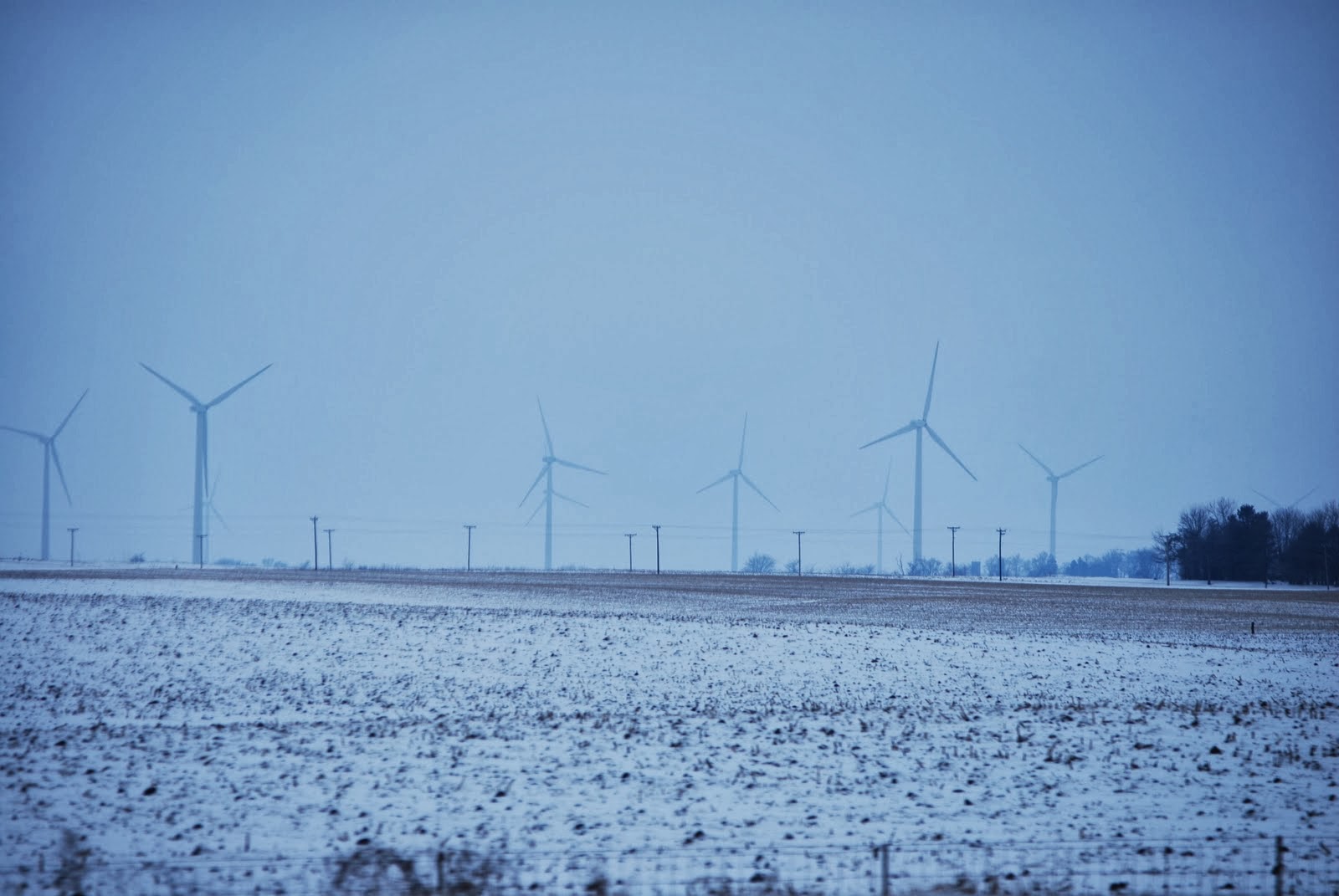
If I have failed to provide local color and scenic detail, you haven't missed much. Neither have we. Iowa was bleak today, cold and bleak and gray and brown. Next August, on the return drive, we expect to see a far livelier landscape. To add to the icy cold were legions of wind turbines (Trina: your worst nightmare) seemingly scattered like wild seeds. Every once in a while our orientation via the interstate lined us up with three or four turbines and it was clear that at times they were designed as "rows" but for the most part they genuinely were planted willy-nilly. Each is bigger than a breadbox. Although they're painted white and the sky was a light gray, they remain the biggest, and the only vertical, thing on the landscape. Old Iowans and Nebraskans must shudder. On they other hand they probably represent employment, or at least temporary employment when they were constructed, and they may (or may not) pay dividends to the farmers upon whose land they sit. So far, whether in the East or now (we're in Lincoln, Nebraska tonight), these turbines stand morosely, their blades rarely moving. And so I ask, how much energy is that Hurculean engineering effort generating?

Lincoln is very much not like the movie: for one thing the city is in color and therefor not seen in the most flattering light. It's cold. And it's the home of Weird Wally, about whom we learned a bit as we drove into town: "Welcome to Lincoln - birthplace and home of Weird Wally". Naturally we were clueless and sensed we'd missed an significant cultural beat or two. There's a lot about which we're less than up to date. Fortunately a few questions later and we were brought up to speed and left with a sense that we were not as backwater-esque as we'd thought: the telltale link.

Lincoln is flat. That it's a sprawl of one-story buildings emphasizes this vertically-challenged city. On the other hand the state capital is one of the few that does not sport a dome and seems to make up for what all the other buildings fail to accomplish. Nebraska bills itself as the home of Arbor Day. A noble cause but one apparently not embraced too much by the locals.

We've spied a Mexican restaurant and after dinner will get a good, long night's sleep. We expect things to pick up after tomorrow. Tomorrow will be entirely the Great Plains and less farming, more ranching or even more, well, more empty. We took a few detours off the interstate to get a better sense of what Iowa and eastern Nebraska were once like. Omaha struck me as somewhat interesting and big enough to offer what the endless string of small towns cannot. Back on the interstate we were struck by the repetitive nature of enterprise and wondered what else was available beyond agricultural machinery dealerships (fascinating, however), Pro Bass Shops, Indian casinos (and riverboat casinos at nearly every bridge crossing the Midwest's great and historic rivers) and truck stops. Iowa80 (worth clicking on the link) bills itself as the world's largest truck stop.  We did not stop.

next years Trucker's Jamboree is July 101-2, 2014
Tomorrow: Cheyenne, Wyoming. I have taken the "Impeach Cheney" and "Deport Lynn Cheney" bumper stickers off the car. Maybe we'll attend a Liz Cheney meet-and-greet!

Friday, December 20, 2013

Friday, December 20

We've accelerated our schedule, if not our pace, in order to be through the Chicago area before a major ice and snow storm arrives. Somehow our calculations failed to factor in a smaller but just as effective spate of freezing rain this morning. Ken had to cling to adjacent cars in order to make his way to our cars. He did manage to get to the cars, move them and de-ice them. Lucca and Marco did not fare much better on their walk; it's perilous trying to maintain one's canine position on three legs on glare ice.

Ken, Lucca and Marco seen through freezing rain.
But the revised plan now has us spending nights in the Davenport, Iowa area (tonight), and then in Lincoln, Nebraska; Cheyenne, Wyoming; Salt Lake City, Utah; and finally Reno, Nevada, before arriving in San Francisco at midday on Christmas Day. No doubt our arrival will be much like the arrival at the the table of a flaming plum pudding. What were you thinking? Cooked goose?